More than your common milkweed is native in Illinois
I don't think I need to explain this process to most
however, to catch everyone up a butterfly life cycle is:
egg > caterpillar > chrysalis > butterfly
however, to catch everyone up a butterfly life cycle is:
egg > caterpillar > chrysalis > butterfly
Milkweed.
Native to the USA.
This is not just the Monarch caterpillar's favorite food.
It is the only food for them.
They will only eat plants that are of the milkweed family.
This is not a situation unique to the Monarch caterpillar.
Certain bugs and critters will only eat certain plants
that developed in the same area as them over millions of years of existence.
that developed in the same area as them over millions of years of existence.
Unfortunately, our tendency to want to control the land
and tame the landscape
and tame the landscape
has resulted in humans unearthing plants native to the area
and putting down grass seed
and exotic plants to imitate English landscape gardens.
Exotics (Any plant that is not native to the area you are planting it)
are interesting to people and well... exotic.
are interesting to people and well... exotic.
They are not native to the area
and therefore, stand out against the backdrop of the native species.
People also had to spend more in order to own an exotic plant,
so, they were also status symbols of a sort.
and therefore, stand out against the backdrop of the native species.
People also had to spend more in order to own an exotic plant,
so, they were also status symbols of a sort.

Over the years though,
exotic plants have woven themselves into what we think of as an
everyday garden variety flower you might plant in the spring every year.
exotic plants have woven themselves into what we think of as an
everyday garden variety flower you might plant in the spring every year.
Not all of these plants are bad.
But, exotic plants *can* be invasive (Out-competing and killing native plants)
Some critters native to the area cannot eat certain exotic plants.
So, the living organisms that were originally here
have had their food supply drastically limited
and strange plants have been planted in their stead.
have had their food supply drastically limited
and strange plants have been planted in their stead.
Sometimes exotic plants are also not adapted to the local climate
and therefore, need more resources to maintain.


and therefore, need more resources to maintain.

Surprisingly in my research of which milkweed plants are native to IL specifically,
I discovered there are actually way way more species than I was originally aware.
I discovered there are actually way way more species than I was originally aware.
Via this website:
Milkweed can be a great plant to have in your yard as most of them are drought resistant for those of you who might forget you are responsible for living things in your yard after you plant them.
(sheepishly raises hand)
Illinois dwellers might be accustomed to dealing with clay rich soil.
Some species of the milkweed family are what can be called "clay busters" due to their long taproots that are able to push through a clay layer of soil that can prevent water drainage.
Some species of the milkweed family are what can be called "clay busters" due to their long taproots that are able to push through a clay layer of soil that can prevent water drainage.
Read more about "clay busters" here:
So, let's start with the more familiar milkweed
and then let's get funky.
Search the Latin name to get more information about where to obtain and how to grow particular species.
This is really meant to expose you to which species are native to Illinois specifically.
To compile this list, I've referenced this excellent resource:
Lady Bird Johnson Wildflower Center
Common Milkweed (Asclepias syriaca):

Most likely the species of Milkweed that you would be most familiar with.
Common is not a misnomer as you can commonly find this milkweed widespread in the USA.
They spread aggressively so they are best suited for roadsides and conservation areas but you can absolutely have them in your garden you just have to cut it back if it's spreading too much for your taste.
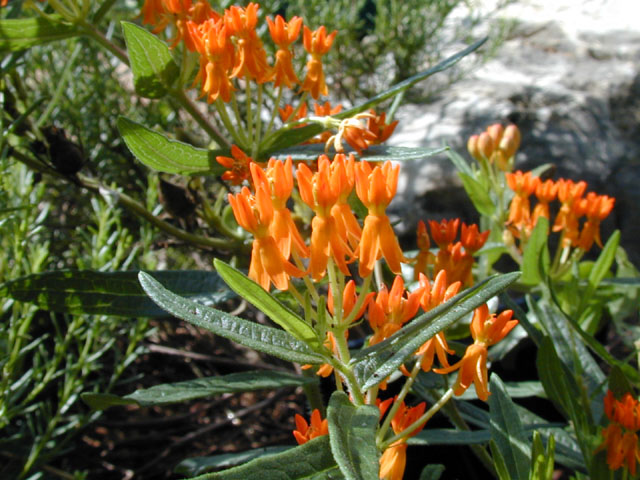
Butterflyweed(Asclepias tuberosa):
http://plants.usda.gov/core/profile?symbol=ASTU
Fairly popular at nurseries that carry native plants for the pretty orange blossoms.
Slow to spread
Slow to spread
Swamp Milkweed(Asclepias incarnata):

This was the 3rd milkweed plant I was ever made aware of through reading more about native plants.
Also more widely available at nurseries selling native plants.
While her sisters are more drought hardy, the Swamp Milkweed likes the earth to be a bit more soggy.
Prairie Milkweed(Asclepias sullivantii):
Prairie Milkweed(Asclepias sullivantii):

Whorled Milkweed(Asclepias verticillata):
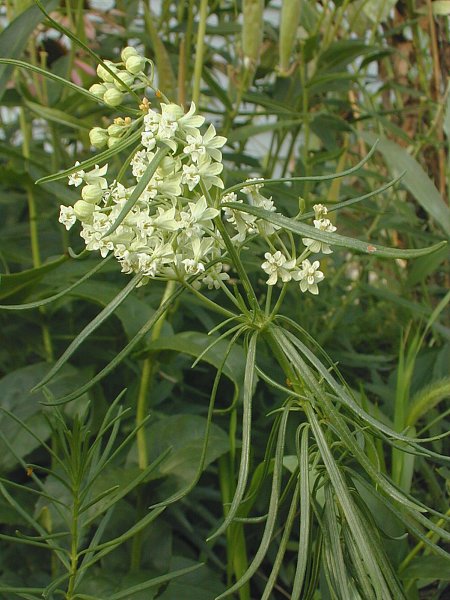
I actually think this is a particularly beautiful milkweed plant, it looks more elegant while it is still a hardy host plant for the Monarch Butterfly and other insects.
Clasping Milkweed(Asclepias amplexicaulis):

(Photo credit: http://vaplantatlas.org/index.php?do=plant&plant=2017)
Poke Milkweed(Asclepias exaltata):

Pretty white blossoms that remind me a bit of Lily of the Valley.
Green Milkweed(Asclepias hirtella):

http://plants.usda.gov/core/profile?symbol=ASHI
Very unique appearance would make for interesting texture in a garden bed.
Very unique appearance would make for interesting texture in a garden bed.
Sidecluster/Woolly Milkweed(Asclepias lanuginosa):


(Photo source: https://www.minnesotawildflowers.info/flower/woolly-milkweed)
Mead's Milkweed(Asclepias meadii):

Aw squishy looking babies.
Oval Leaf Milkweed or Dwarf White Milkweed (Asclepias ovalifolia):

Another species I find to be fairly pleasing to the eye.
Aquatic Milkweed(Asclepias perennis):

http://plants.usda.gov/core/profile?symbol=ASPE
Check out this little beauty.
Check out this little beauty.
Purple Milkweed(Asclepias purpurascens):

So pretty!
Fourleaf Milkweed(Asclepias quadrifolia):

Just beautiful.
Showy Milkweed(Asclepias speciosa):

http://plants.usda.gov/core/profile?symbol=ASSP
Another plant that is notable for it's unique texture that would stand out nicely against short large broad-leafed plants in a garden bed.
It is being perched upon by a Western tiger swallowtail butterfly.
http://plants.usda.gov/core/profile?symbol=ASSP
Another plant that is notable for it's unique texture that would stand out nicely against short large broad-leafed plants in a garden bed.
It is being perched upon by a Western tiger swallowtail butterfly.
Slim Leaf Milkweed(Asclepias stenophylla):

Redring Milkweed(Asclepias variegata):

http://plants.usda.gov/core/profile?symbol=ASVA
These are very unique and beautiful blossoms that look waxy to the touch and almost look like little cherry blossoms in a ball.

http://plants.usda.gov/core/profile?symbol=ASVA
These are very unique and beautiful blossoms that look waxy to the touch and almost look like little cherry blossoms in a ball.
Green Comet Milkweed(Asclepias viridiflora):

http://plants.usda.gov/core/profile?symbol=ASVI
Green Antelope Horn(Asclepias viridis):

http://plants.usda.gov/core/profile?symbol=ASVI2
Green Antelope Horn(Asclepias viridis):
http://plants.usda.gov/core/profile?symbol=ASVI2
I hope that you have come away from this article with a greater understanding and appreciation of the beauty and utility of the milkweed plant.
Please post below if you have any tips or insight for planting milkweed.
Thanks for reading!
Please share your experiences planting milkweed below on or on my Facebook page.
Your pal,
Maeghan
Please post below if you have any tips or insight for planting milkweed.
Thanks for reading!
Please share your experiences planting milkweed below on or on my Facebook page.
Your pal,
Maeghan


Comments
Post a Comment