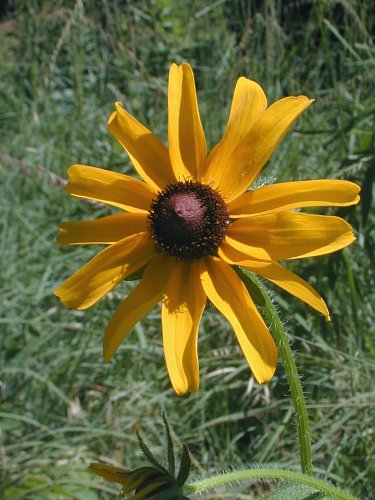
Flower: Black-Eyed Susan (Rudbeckia hirta)
What are these yellow flowers?
And why did you bother putting the latin name? What a boorish show-off!!
Well I will get the Latin name thing in a bit...
Click below to learn more:
I would like to start out by featuring a plant that is native to our area and also has a wide distribution.
I have provided the link above for more in-depth information on it. The part that interests me the most is what lifeforms benefit from the lovely little yellow flower's presence.
Taken from http://www.illinoiswildflowers.info/prairie/plantx/be_susanx.htm :
"Faunal Associations: The composite flowers appeal to a wide range of insects, particularly bees and flies, as well as some wasps, butterflies, and beetles. The bees collect pollen or suck nectar, and include Little Carpenter bees, Leaf-Cutting bees, Green Metallic and other Halictine bees, Andrenid bees, and others. Some Andrenid bees, such as Andrena rudbeckiae and Heterosarus rudbeckiae, prefer visiting the flowers of Black-Eyed Susan and closely related plants. Among the flies that visit the flowers, Syrphid flies, Bee flies, and Tachinid flies are well represented. The caterpillars of
 Chlosyne nycteis (Silvery Checkerspot) feed on the leaves. Many mammalian herbivores are not particularly fond of the coarse leaves – they have low food value, and there have been occasional reports of this plant poisoning cattle and pigs. The seeds are eaten occasionally by goldfinches."
 |
| http://www.flickr.com/photos/plant_diversity/ |
If you need some more images of this flower a good source is Flickr:
http://www.flickr.com/search/?q=Rudbeckia%20hirta
Check check check check check check a check it out.
Ok.
So about the Latin name.
When I say Black-Eyed Susan.
You could have very well thought of 5 different plants and you would have been right.
Which is why I have to specify using the Latin name Rudbeckia hirta
Here is an example of "Black Eyed-Susans":
http://www.naturehills.com/catalog/perennials/black_eyed_susan.aspx
Yes they are all very similar in appearance however Latin names are very important when determining what you are actually planting. They may be "cultivars" or " A race or variety of a plant that has been created or selected intentionally and maintained through cultivation " or they may be from a different continent altogether.
Plants native to your region have had the opportunity to evolve and thrive in your region and in your soil for millions of years, therefore they will do better when planted in conditions that they evolved in.
For this reason, the insects that evolved alongside the pants for those millions of years will sometimes have adapted to eat only plants that are native to the area they evolved in. So if you wish to attract a certain species by planting its host plant in your yard, you had better be checking the Latin name instead of the common name as they are very vague most of the time.
Another reason to consider the Latin name and origins of the plant you have chosen to grow in your yard is that over the years, nature has created checks and balances for plants and animals typically by using the food chain. If there is a foreign species that spreads aggressively and the native creatures are not adapted to eat it, it can grow out of control and out compete native plants(or creatures) for resources.
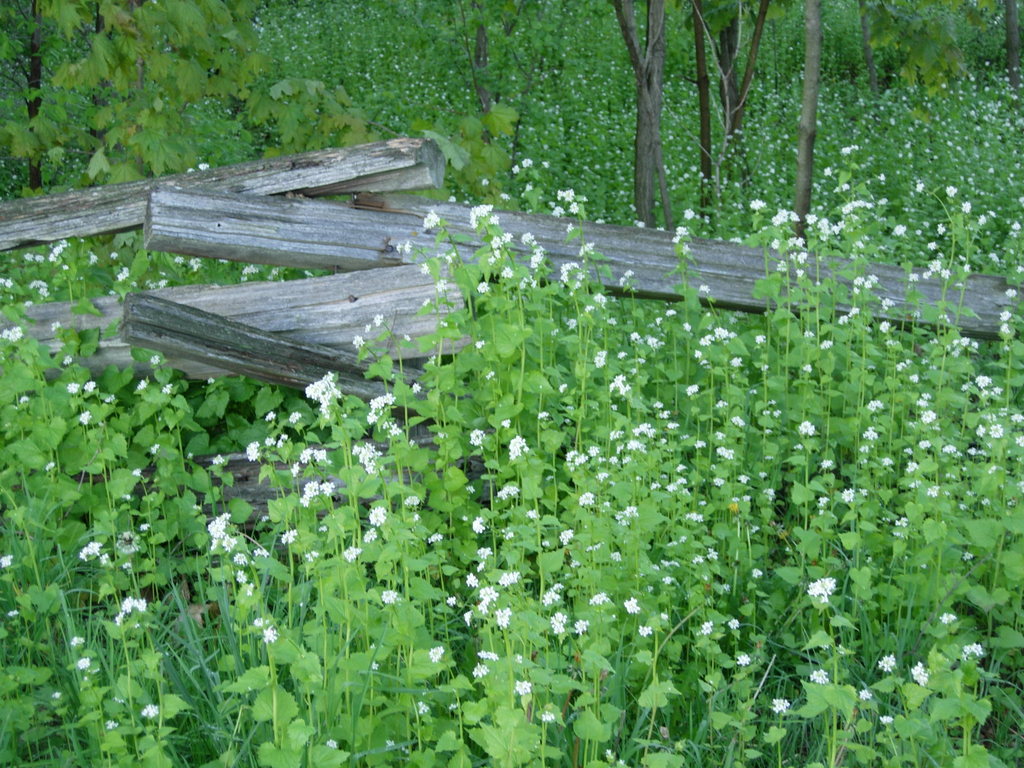 |
| Pull those suckers out |
Such is the case with the exotic Garlic Mustard (Alliaria petiolata) originally from Europe which is considered an invasive species.
You can read an article here about how they are considering using a Weevil to eat Garlic Mustard which is undoubtedly found in abundance anywhere within a 1 mile radius of your house. This method of control is being considered as in Europe it has more than 70 enemies and here it has next to none.
In summary get ready to see more Latin names. And like it.
You can read an article here about how they are considering using a Weevil to eat Garlic Mustard which is undoubtedly found in abundance anywhere within a 1 mile radius of your house. This method of control is being considered as in Europe it has more than 70 enemies and here it has next to none.
In summary get ready to see more Latin names. And like it.
-M


Comments
Post a Comment